Workforce Transformation
The Touch Economy: Human Skills and Skilled Trades Are Rising
WORKFORCE TRANSFORMATION
ChatGPT
AI can analyze data in seconds.
It can generate code, draft presentations, summarize meetings, and automate tasks that once signaled white-collar value.
So why are employers putting more weight on communication, judgment, stakeholder management, and hands-on technical trades?
Because as AI handles more digital work, the value of distinctly human work rises.
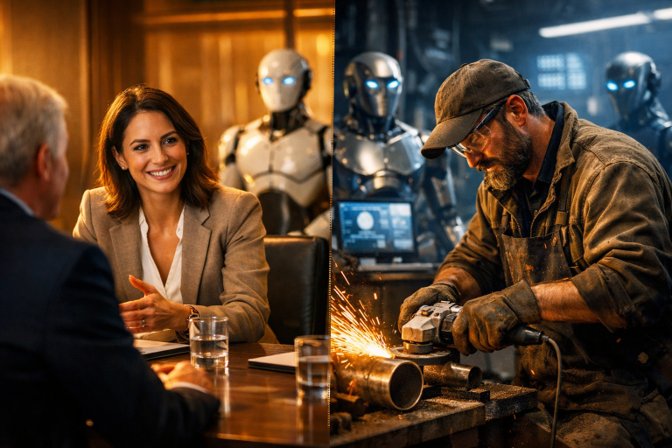
Call it the touch economy: a labor market where trust, presence, craftsmanship, and human accountability are becoming premium assets.
The Flip Few Expected
For years, the assumption was that automation would hit manual labor first while knowledge workers stayed relatively protected. Instead, generative AI has moved quickly into parts of research, writing, design, and programming.
That has not made human talent irrelevant. It has changed which kinds of talent feel scarce.
What looks more valuable now is work that AI struggles to replicate well: earning trust, reading a room, managing conflict, leading change, building relationships, and creating tangible results in the physical world.
Why Soft Skills Became Hard Currency
Communication matters more when teams need someone who can turn AI output into decisions people understand and act on.
Stakeholder management matters more when new tools disrupt workflows, power structures, and accountability.
Judgment matters more when speed increases but certainty does not.
These are not decorative skills. They are operational skills. In many environments, they are what make AI usable.
The Skilled Trades Rebound
The same logic helps explain renewed interest in the skilled trades.
Electricians, plumbers, HVAC technicians, welders, and other craft professionals operate in environments that are physical, variable, and deeply human. Their work depends on spatial reasoning, dexterity, situational judgment, safety, and customer trust. It produces visible outcomes, solves concrete problems, and cannot simply be virtualized away.
That helps explain why younger workers are reassessing career paths. For many, the appeal of trades is not anti-technology. It is anti-abstraction. They want work with a clearer connection between effort and outcome. They want skills that exist in the real world, not just inside software. They want careers that feel durable.
The Market Re-Sorts Value
This does not mean computer science is obsolete or that office work is in decline across the board. It means the market is re-sorting value.
AI literacy is becoming a baseline. Human effectiveness is becoming the differentiator.
The winners in this economy will not be the people who ignore AI. They will be the people who combine technical fluency with human leverage. They will know how to use AI tools, but also when to override them, explain them, humanize them, and apply them in contexts where trust still matters.
Your Four-Point Playbook
First, learn the tools. AI competency is no longer optional in many fields.
Second, build communication skills that travel. The ability to explain complexity clearly is becoming a multiplier across roles.
Third, strengthen judgment-based skills such as leadership, ethics, prioritization, and client management. Those are difficult to automate because they depend on context.
Fourth, do not underestimate the long-term value of skilled physical work. In a digital economy, tangible competence stands out.
The Real Opportunity
The labor market is not moving away from intelligence. It is broadening its definition of it.
When information became abundant, attention became valuable.
When routine work became automated, creativity gained value.
Now that AI can mimic parts of knowledge work, the premium is shifting again—toward judgment, connection, and craftsmanship.
That is the real opportunity in the touch economy.
The future will not be shaped only by people who can use powerful tools. It will be shaped by people who can build trust, make sound decisions, and create outcomes that matter in the real world.